
CMI Level 521 Assignment: Using Data and Information for Decision Making Task
CMI Level 521 Overview of assessment tasks
Each task in this assessment brief has been developed to enable you to evidence achievement of the learning outcomes and assessment criteria for CMI 521: Using Data and Information for Decision Making. Each of the assessment criteria must gain a pass outcome for you to successfully achieve the unit.
Preparation for the assessment
- Before you begin the assessment brief please read the CMI 521 unit specification thoroughly as only the content related to the achievement of the assessment criteria will be assessed.
- Research the topics being assessed. Suggested reading/web resources are provided on the CMI 521 unit specification. Your tutor may signpost you to relevant resources. Additionally, you may access excellent online resources at ManagementDirect https://members.md.cmi.org.uk. Please note that if you have a customised site the link will differ, please contact your Centre for clarification.
- If you are enrolled on the Trailblazer Apprenticeship programme you are encouraged to review the Apprenticeship Standard for Operations/Departmental Manager.
Completing the assessment brief
- The assessment brief contains a series of tasks which are clearly referenced to the relevant assessment criteria and indicative content.
- Refer to the Assessment Guidance Table at the end of the assessment brief which outlines the requirements for a Pass or Refer.
- Evidence must be provided in the evidence booklet. Additional work based evidence such as plans or documentation (which has been referred to within the main text) should be included at the end of the booklet marked ‘Work Based Evidence’. Appendices are not a requirement of this assessment brief. If appendices are included these will not be marked or moderated by the CMI.
- Work based evidence must be accompanied by a supporting statement in the learner evidence box, to explain the link to the assessment criteria. Work based evidence (where required by the task) must not exceed SIX (6) pages. Files embedded in the booklet must not exceed 10MB.
- The evidence booklet must be completed in a professional manner (e.g. applying business conventions for writing formal reports) and by using Microsoft Word, Rich Text Format or another compatible software programme and not in a PDF format.
- An appropriate referencing system (such as Harvard Referencing) must be used to ensure the original source(s) of quotations or models can be verified.
- Finally, you must sign the Learner Authenticity statement (an electronic signature is accepted).
Learner support
For information regarding policies and procedures for assessment (e.g. special assessment arrangements, learner support, appeals, complaints, certification, confidentiality, plagiarism) you should contact your tutor or Centre manager and refer to the CMI Level 5 in Management and Leadership syllabus.
Introducing Assessment Brief
The ability to analyse and manage data and information can lead to increased competitiveness, productivity and customer satisfaction and support innovation. With data and information volumes increasing at an unprecedented rate, the ability to interpret, use and harness this can become an organisational and management challenge. Assessment brief CMI 521 has been designed to equip learners with an understanding of the purpose and practices of interpreting, managing and presenting business data and information to inform decision making at different levels within an organisation.
Do You Need Assignment of CMI Level 521 Assignment
Order Non Plagiarized Assignment
CMI 521 Assessment Tasks And Word Count
Assessment brief CMI 521 features the following assessment tasks. Further detail is provided against each assessment task within the brief.
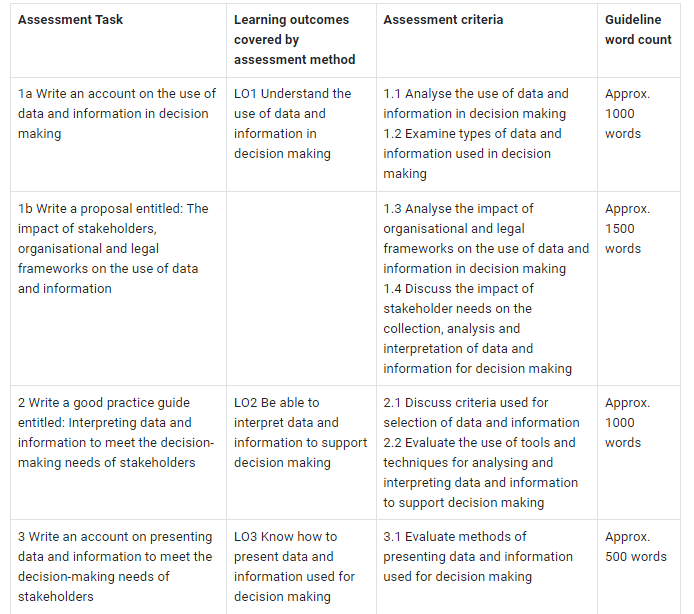
Guideline word count
The written word, however generated and recorded, is still expected to form the majority of assessable work produced by Learners at Level 5. The amount and volume of work for this unit should be broadly comparable to a word count of 3500-4000 words within a margin of +/-10%. The excessive use of word count is not grounds for CMI 521 Page 3 of 8 Version 1 referral, however the CMI reserve the right to return work to the Centre for editing and resubmission by the Learner.
The following are excluded from inclusion in word count, if used and not required by the assessment brief an introduction to a job role, organisation or department, index or contents pages, headings and sub headings, diagrams, charts and graphs, reference list or bibliography, reflective statement drawn from undertaking the assignment and how this has impacted on the learner’s work.
Please see the CMI Assessment Guidance Policy for further guidance.
The Use Of Data And Information In Decision Making
Understanding the use of data and information in decision making across the different levels of an organisation is a fundamental skill. An important element is an understanding of the types, sources and uses of data and information.
A manager, who has an in-depth understanding of how data and information can be used, will be able to actively participate and lead in decision making at a group, team, department, project and business unit level in a variety of organisational settings.
Task 1a
You are required to write an account on the use of data and information in decision making.
Using examples, the account must:
i. Analyse the use of data and information in decision making (AC1.1)
ii. Examine THREE (3) types of data and information used in decision making (AC1.2)
Guidance for completion of Task 1a
- Within the account you should include sub-headings. You may choose to include tables and diagrams (as appropriate) to support your discussion.
- You are encouraged to consider the use of good practice examples from an organisation you know well or have researched.
- In writing your report you might want to clearly define what you mean by data and information in the context of your chosen organisation.
- Your discussion should be underpinned with relevant theoretical principles and models.
- Please refer to the indicative content for each assessment criteria (AC) outlined in the unit specification.
Get the Solution of CMI Level 521 Assignment. Hire Experts to solve this assignment Before your Deadline
Order Non Plagiarized Assignment
CMI Level 521 Scenario
DKM&X is a large industrial company that manufactures tools and equipment and also offers some consultancy services.
450 staff are based at its UK headquarters. The company has various strategic business units (SBUs) and offices located across the UK, which make use of both internal and external data and information sources for benchmarking, performance management and reporting for internal use, customers, professional services clients and other stakeholders.
You lead a team consisting of full time and part time staff. Some staff are based on site at the UK HQ whilst others are mobile travelling to customer sites for face to face meetings. Within your remit you also liaise with a range of external stakeholders including customers, suppliers and regulatory organisations.
A key aspect of your role is to make decisions based on data and information from internal and external sources. On a monthly basis, you are required to present performance and benchmarking data and information to the senior management team. You are also required to regularly provide compliance data and information to regulatory bodies. On a daily basis, your team access data and information on product usage, production and quality, customers and suppliers in line. Managing data and information lawfully and in accordance with organisational and legal requirements is a key aspect of the team’s role.
Task 1b
Basing your response on the scenario, your own experience of managing data and information in the workplace or using examples from an organisation you know well or have researched:
You are required to write a proposal on ‘The impact of stakeholders, organisational and legal frameworks on the use of data and information’.
Your proposal must use examples to:
i. Analyse the impact of TWO (2) organisational and ONE (1) legal framework on the use of data and information in decision making (AC1.3)
ii. Discuss the impact of stakeholder needs on the collection, analysis and interpretation of data and information for decision making (AC1.4)
Guidance for completion of Task 1b
- Within the account you should include sub headings. You may choose to include tables and diagrams (as
appropriate) to support your discussion. - You are encouraged to consider the use of good practice examples from an organisation you know well or have researched.
- Your discussion should be underpinned with relevant theoretical principles and models.
- Please refer to the indicative content for each assessment criteria (AC) outlined in the unit specification.
Interpreting Data And Information To Support Decision Making
How to interpret data and information sources and types for use in different organisational contexts for decision making is an important skill. This also includes assessing data quality (clean data), currency, accuracy and relevance.
Task 2
You are required to create a good practice guide entitled ‘Interpreting data and information to support decision making’. The good practice guide will be used by other managers in the organisation to enable them to get a better understanding of how to interpret data and information to support decision making.
The good practice guide must:
i. Use examples to discuss criteria used for selection of data and information (AC2.1)
ii. Evaluate the use of tools and techniques for analysing and interpreting data and information to support
decision making (AC2.2)
Guidance for completion of Task 2
- Within the good practice guide you should include sub-headings. You may choose to include tables and diagrams (as appropriate) to support your discussion.
- You are encouraged to consider the use of good practice examples from an organisation you know well or have researched.
- You are not expected to present data and information as part of your response.
- Your discussion should be underpinned with relevant theoretical principles and models.
- Please refer to the indicative content for each assessment criteria (AC) outlined in the unit specification.
Presenting Data And Information Used For Decision Making
Being able to present data and information to support decision making at different levels in an organisation and in different contexts is an important skill. This includes being able to present data and information in different formats to meet stakeholder needs and in different decision action cycles, which could be hourly, daily, monthly or on a yearly basis.
Task 3
You are required to write an account on methods of presenting data and information to meet the decision-making needs of stakeholders.
Using examples, the report must:
i. Evaluate TWO (2) methods of presenting data and information used for decision making (AC3.1)
Guidance for completion of Task 2
- Within the report you should include sub-headings. You may choose to include tables and diagrams (as appropriate) to support your discussion.
- You are encouraged to consider the use of good practice examples from an organisation you know well or have researched.
- Your discussion should be underpinned with relevant theoretical principles and models.
- Please refer to the indicative content for each assessment criteria (AC) outlined in the unit specification.
CMI Level 521 Assessment Guidance
| Refer | Pass |
|---|---|
| ● The submission is incomplete ● Tasks are incomplete ● Not all assessment criteria have been met ● No examples are used or the examples given do not match the requirements of the assessment criteria ● Evidence is ● Unclear ● Technically incorrect or inaccurate ● Biased ● Unprofessional language ● Poorly structured and presented ● Ideas are under-developed ● Lacks sufficient detail to show understanding of the topic ● The application of different perspectives, approaches or schools of thought is unclear or inappropriate ● Little or no evaluation of evidence has taken place ● The ability to make judgments and solve complex problems has not been evidenced ● Evidence is not directly attributable to the learner ● External sources of information are not acknowledged ● Work based evidence or artefacts (e.g. planning documents or presentation slides) do not meet the requirements of the assessment criteria and are not current (within 5 years) |
● All tasks have been completed ● All assessment criteria have been met ● Examples given are well chosen and match the requirements of the assessment criteria ● Evidence is ● Well written and presented ● Contains a breadth of examples ● Accurate ● Current (e.g. use of up to date legislation) ● Authentic ● Inclusive ● Coherent ● Credible ● Technically correct ● Evidence shows understanding and application of different perspectives, approaches or schools of thought and the reasoning behind them. ● Evidence shows the learners ability to evaluate evidence and solve problems to achieve set outcomes. ● Evidence used from external sources has been correctly referenced ● Evidence is directly attributable to the learner ● Work based evidence or artefacts (e.g. planning documents or presentation slides) match the requirements of the assessment criteria and are current (within 5 years) |