
BIS2006 Management Information Systems Assignment Brief Tri 1 | APIC
BIS2006 Assignment Overview:
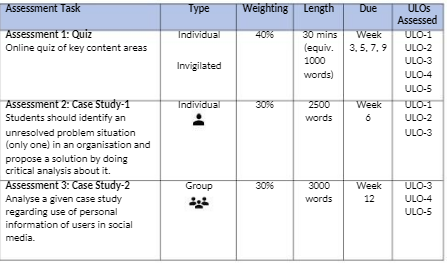
Note for all assessments tasks:
- Students can generate/modify/create text generated by AI. They are then asked to modify the text according to the brief of the assignment.
- During the preparation and writing of an assignment, students use AI tools, but may not include any AI- generated material in their final report.
- AI tools are used by students in researching topics and preparing assignments, but all AI-generated content must be acknowledged in the final report as follows:
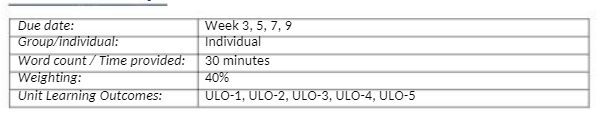
BIS2006 Assessment 1: Online Quiz
Do You Need Assignment of BIS2006 Question
Order Non Plagiarized Assignment
BIS2006 Assessment Details:
These online quizzes will assess your knowledge of key content areas of learning materials from weeks 1 to 9. For successful completion of the quizzes, you are required to study the material provided (lecture slides, tutorials, and reading materials), engage in the unit’s activities, and participate in the discussion forums. These quizzes will be completed online through the APIC Online Learning System (OLS).
Tableau is cost-effective as it only cost them $70 per month for the subscription. After rolling out their Big Data strategy, QMart have nearly doubled their annual sales to $878,850 and welcomed an additional 15,000 customers in 202x, a 10% increase in total customer count.
In contrast, Shop Smart used Microsoft Access but eventually used SQL to talk directly to the company’s POS database. Luckily, they have an in-house IT personnel specialising in SQL who made all the necessary queries and reports that they need for organisational decision-making. However, they are now in need of an analytics software that could make reports in an understandable format in the form of dashboards and worksheets to help simplify decision-making. Hence, they are currently investigating the possibility of also using Tableau and have hired an external consultant to help them in this regard.
Shop Smart said that the three foremost analytics questions they asked:
- How can we further improve our services?
- How do we reduce delivery times?
- How can we find hidden needs and fill up with new products and services?
The problems they are facing include information silos, decentralised data, lack of data analytics and visualisation strategies, lack of business intelligence skilled personnel and lack of customer relationship management system solution.
Initial investigation revealed that possible CRM solutions includes cloud-based CRM such as Zoho CRM, Salesforce, SugarCRM or Monday.com. However, they are still at a lost whether to go proprietary or open-source, and assuming they will use Tableau as their BI system, will it interface well with their CRM solution of choice? They would like you to help them in this regard.
Once you formulated your recommendation solution, you now need to provide a critique of the proposed solution. Your critique should include a discussion of the features of the proposed enterprise CRM solution, its functions in support of business processes, such as its ability to produce customer insight reports, including a justification of its “fitness” to the organisational needs, such as alignment to the company’s strategic goals (such as, will this CRM solution help better understand customer needs?). It may also include cost/benefit calculations, such as ROI, payback analysis, and Net Present Value (NPV). Also, will the proposed CRM solution interface well with Tableau?
You are required to describe the role of information systems in supporting operations and organisational decision making (ULO-1), discuss the features of enterprise systems and their functions to support business processes (ULO-2), and critique the alignment of an organisation’s information systems strategy and business strategy (ULO-3).
The following areas should be covered in your assignment using the case study context:
- Provide a brief description of the organisation
- Provide a description of the current information systems problems (e.g., information silos, lack of BI capabilities, etc) and describe the role of information systems in supporting operations and organisational decision making (e.g., creation of dashboards and worksheets)
- Discuss the features of enterprise systems and their functions to support business processes and how its implementation will provide real benefits to organisation (e.g., competitive advantage, improved customer traffic, improved sales and profit, etc)
- Critique the information system solutions proposed. Are they aligned to the company’s business strategic vision?
- A report of 2500 words summarising your analysis must be submitted by the due date. Reasonable assumptions are allowed. Penalty for Late submission: a deduction of 5% of the total mark shall be imposed on each of the next subsequent days.
Submission requirements
- Use a typical report structure, with a Cover Page, Table of Contents, Introduction, Body, Recommendation/Conclusion and References format. Executive Summary is not required in this report.
- The References are excluded in the word count.
- The Cover Page should clearly indicate the name of the person submitting the report and the word count.
- You can use each question above as Headings in the Body of your report.
- All References should reflect quality citations from relevant academic journals and adhere to the correct Harvard format (Wikipedia NOT allowed).
BIS2006 Assessment 3: Case Study-2

Assessment Details:
Read the case study and the article below, then complete the exercise at the end. To answer the exercise questions provided, you will need to conduct further research about the topic (read the article below see the list of references included for further research).
Case Study
eBuggy
eBuggy is a transportation service that was rolled out in 200X after its founder, Bud Rhode couldn’t get a taxi in New York during a snowstorm one December night. It originated from the idea, “What if you could request a ride from your phone?” Today, eBuggy boasts an annual revenue of over $11 billion, a market capitalization rate of $74 billion, and over 19,000 employees. With 75 million global customers and three million dedicated drivers in 83 countries, Grab has been a legitimate game-changer in the ride-sharing services market. eBuggy wanted to make it easy as 1-2-3 to get a ride.
Customers just need to do is to open their mobile phone, tap a button, and find an affordable ride in minutes. This is aligned to the company’s vision and mission which is to “getting a ride is as easy as saying 1-2-3.” What makes eBuggy so incredibly successful is not its business model, but how easy it is for people to work inside of its business model. What eBuggy has exposed is that companies can transform a business if they engage with customers more effectively. But getting that engagement is tough. According to Sylvia Chan, chief systems architect for eBuggy, “Each person connecting to eBuggy is having a unique experience with highly personalized data.
This level of personalization at the scale eBuggy operates brings problems. eBuggy’s business is not one where the data can be cached or deployed through CDNs [content delivery networks]. What complicates issues is that mobile networks are simply not as fast as a traditional PC. As an example, the session time for a typical mobile device is ten times longer than a PC.”
“Another challenge is that eBuggy cannot afford a system failure. Ever,” said Chan. “If a eBuggy customer cannot get a Grab car, then they will switch to another app.
There is no brand loyalty. The systems must always work.” Chan lists three key areas that eBuggy needs for a fully redundant system:
- Performance: What types of tests do you run to ensure that your systems keep running?
- Data: How can data operate in an environment where a data connection is intermittent?
- Future proofing: What technologies does eBuggy invest in to improve efficiencies in its systems?
A common thread through all of eBuggy’s systems is performance, performance, and performance. Each technology is chosen because it is the most stable and delivers the fastest response. In addition to this, eBuggy looks to ensure that tools work independently of each other and are destructible. To this end, eBuggy actively attempts to crash its systems, including networks, databases, and APIs. The system must work even when it is down. Starting with the mobile apps: eBuggy does not use HTML5 or hybrid solutions in them. All the coding is completed with native code using the performance and analysis tools in Xcode and Android Studio.
The level of performance does not stop at the server. The communication channel, or RPC, is also modified. eBuggy ‘s version is called TChannel. It is based on Twitter’s multiplex RPC protocol, Mux. eBuggy needed to invent its own RPC communication channel because it supports more languages than Twitter. Chan added, “We are even looking to replace HTTP+JSON, a typical REST API, with Thrift, as our tests are showing that it is 20 times faster. We need all the speed we can get.”
Performance for eBuggy goes to extremes with data. The typical data structure for a company is a relational database. The problem that eBuggy sees with relational databases is that the whole system can come down if the database is not available.
eBuggy uses Big Data systems as a foundation for its technologies, with tools such as Riak, Postgres, Redis, and MySQL. Also, the company is extending MySQL with its distributed column store to orchestrate the data processes. eBuggy uses drivers’ phones as the method of distributing data, achieving a kind of “super distributed computing.” The result is that stress on replicating data is eliminated from the data centres. The trick is achieved by the phone checking in with a server every four seconds to receive an encrypted digest. If a server does not respond, the phone moves to a new server. The whole data environment is redundant. Also, the more drivers, the more redundancy is added to the system.
In addition to the core supply-and-demand dispatch systems, eBuggy does have a third system: Disco. Chan said, “Disco is the dispatch optimization system. Disco’s main function is to match supply with demand. Disco, however, allows Grab to investigate the future. We can match predictive supply and demand, whereas our old system could only match what we knew then.” The advantage Disco provides eBuggy is clear: Through data, Grab can help busy drivers keep efficiently picking up riders. To do this, eBuggy needs a global index that requires a massive amount of data: over 1 million writes per second. eBuggy is using Google’s S2 Geometry Library to break down the data and get it out